Installation Instructions
Aqua Systems heat exchangers can operate as either a condenser or an evaporator. We recommend installing a vent and drain plugs where freeze cleaning may be required and fully insulating the unit to improve overall heat transfer performance.
Step 1: Connect refrigerant gas to the top refrigerant port.
Step 2: Connect refrigerant liquid to the bottom refrigerant port.
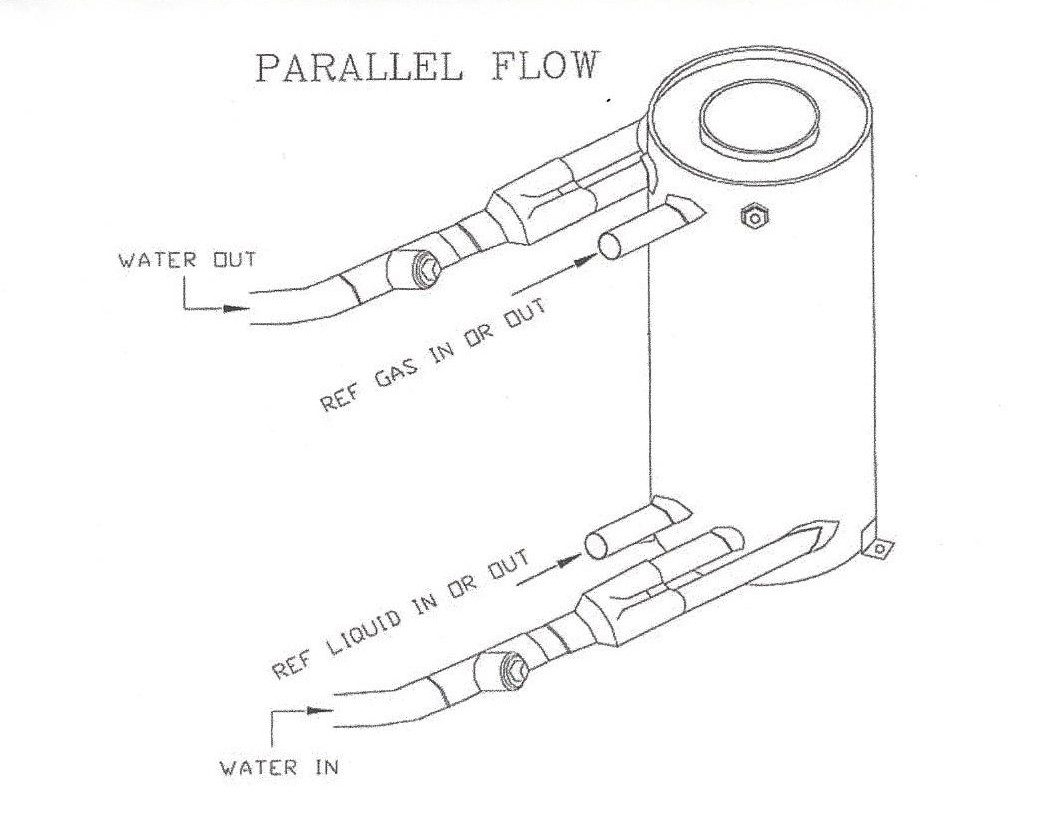
Step 3: Configure the unit for either Parallel Water Flow or Series Water Flow.
Parallel Water Flow
Commonly used for closed loop installations.
Suitable regardless of water or fluid temperatures.
Recommended when leaving water temperature may approach freezing.
Maximum flow rate is 12 GPM.
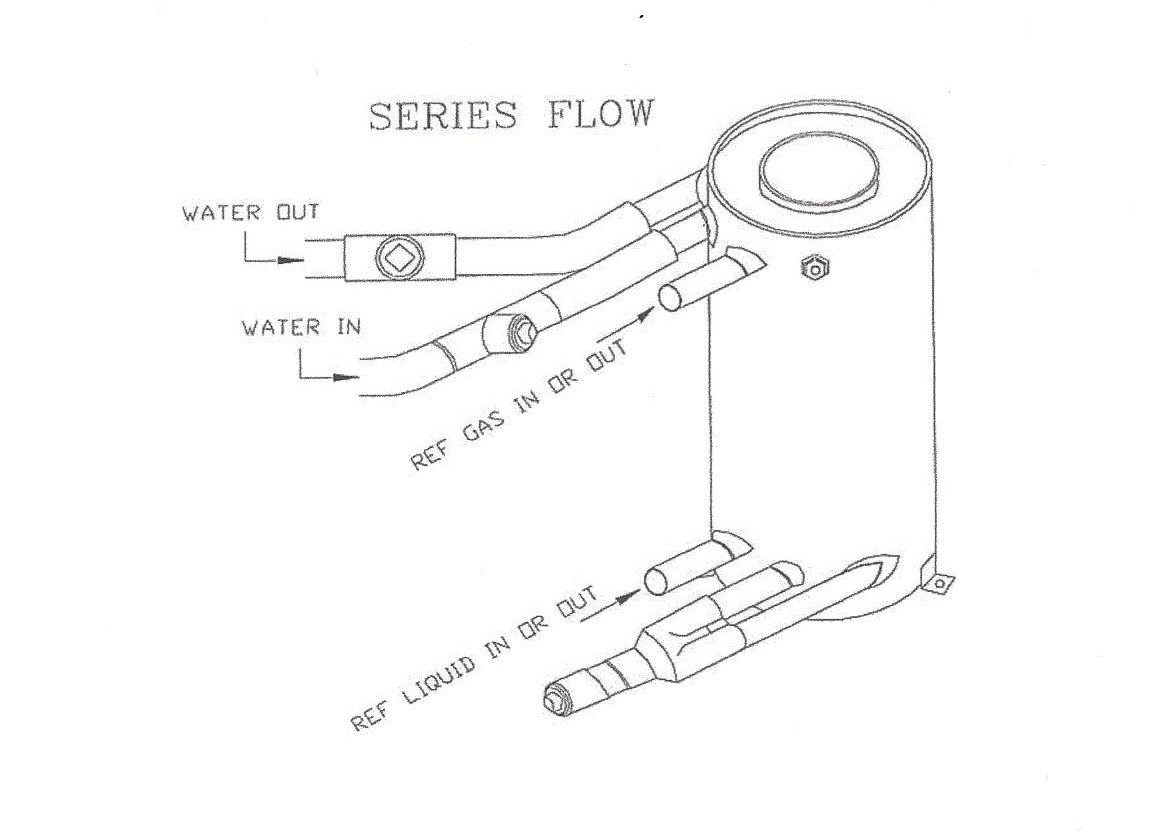
Series Water Flow
Typically used for one pass evaporator installations.
Leaving water temperature must remain above freezing with safety margin.
Maximum flow rate is 6 GPM.
Not recommended for models larger than S-4, S-4R, CN4 or CN4R.
Freeze Cleaning Instructions
Set up water piping so that water flow to the heat pump can be turned off.
Use boiler drains on the top and bottom water connections ensuring the heat exchanger will vent at the top and drain at the bottom.
Shut off water flow to unit and open the vent and drain for the heat exchanger.
Configure the heat pump controls so that the heat exchanger is operating as the evaporator.
After you have confirmed the heat exchanger has fully drained, manually engage the compressor contactor and allow the compressor to run until the suction pressure drops below 20 PSI.
Configure the heat pump controls so that the heat exchanger is operating as the evaporator.
Shut down the compressor and allow system pressures to equalize. Close the vent opening.
Restore water flow and flush the heat exchanger through the drain until the discharge runs clear.
Close the drain opening and return the system to normal operation.